



Building blocks for a greener skyline
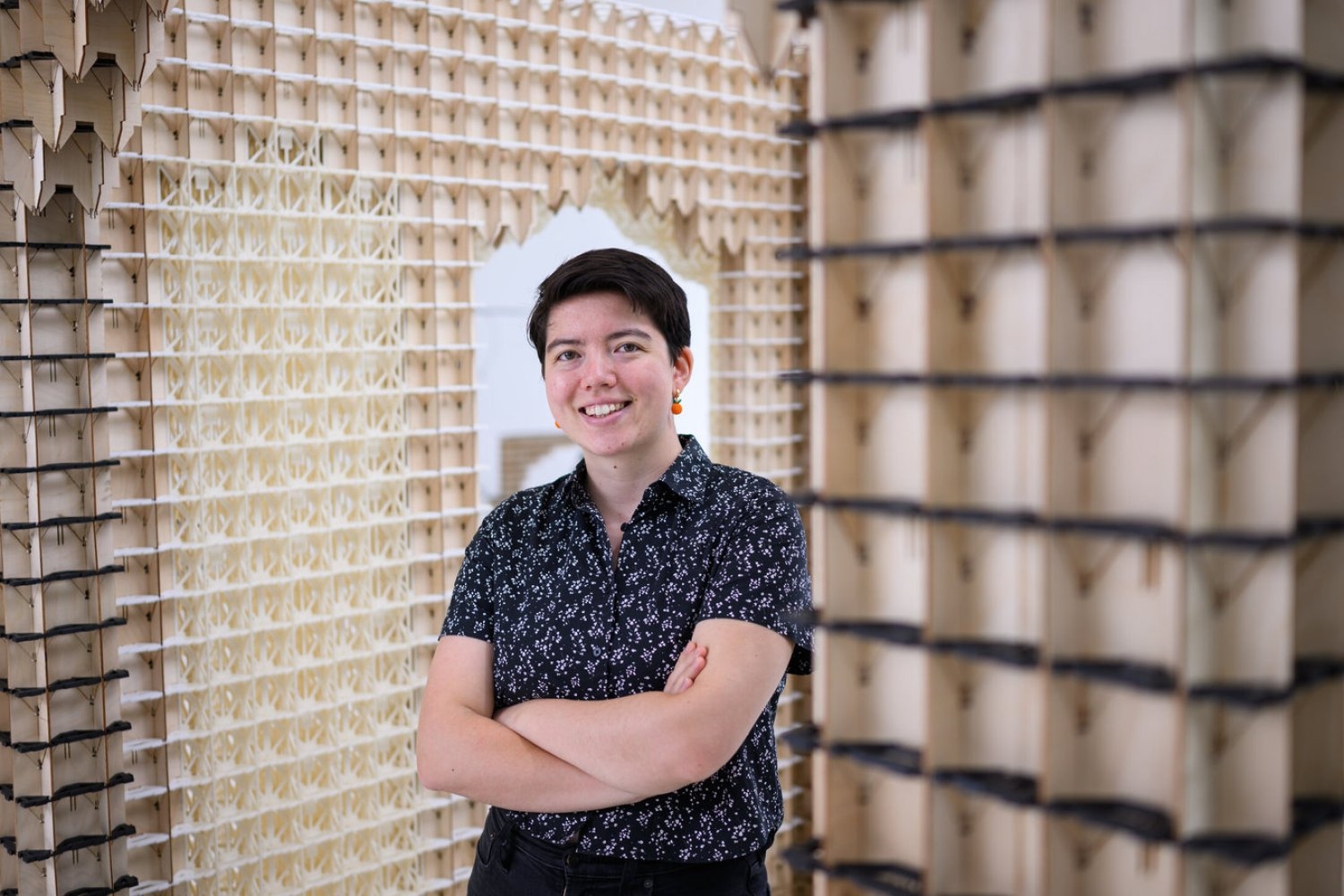


The construction industry is often cited as contributing over one-third of global greenhouse gas emissions, in large measure because buildings use more material than they need to. Miana Smith ’21, SM ’23, PhD ’26, a recent graduate and visiting researcher who is part of the Center for Bits and Atoms research team in MIT's Program in Media Arts and Sciences, has spent years trying to fix that by reimagining how buildings get put together.
Engineers already know how to design more structurally efficient buildings. For example, in buildings framed with structural steel, it's estimated that 30-40 percent of the steel could be removed without weakening it, simply by customizing the cross sections of the beams.
Although this solution seems straightforward, implementing it is not. “The process of producing a custom part requires not just one-off design and engineering work, but also often impractically high manufacturing costs,” Smith notes. Once produced, all the custom parts require highly skilled laborers to install them on site. As a result, builders default to using more material than they need, because oversized, uniform parts are simply cheaper to produce and assemble at scale.
Another option is digital fabrication: automated methods like 3D printing and robotic assembly. While this offers adaptability — a way to decouple design complexity from the overall cost of production — the trade-off is precision. Extruding concrete or placing framing members across a 10-meter span for a building often demands a machine accurate to a few millimeters, and machines that precise are both difficult to manufacture and expensive.
Lego logic
Smith's research inverts that logic. Instead of a precise machine and a simple material, she builds a complex material, a small lattice block Smith’s lab calls a voxel, that even a basic, imprecise robot can assemble correctly.
She compares the concept to the design principle behind Lego bricks. “You can take a very imprecise assembler — in this case, a child — and have them build something that's very precise,” Smith says, “not because a child is somehow uniquely able to build out of Lego blocks and nothing else, but because the blocks themselves have a clever mechanical design that prevents error accumulation as the structure grows.”
Smith’s voxels might look vastly different, but like Legos, they effortlessly snap into place when placed on top of one another. Her robots' margin of error is about 10 millimeters, far greater than the roughly 100-micron tolerances of most industrial robots — a number that would look like a failure to most engineers.
It isn't one, Smith says, because her blocks are built to absorb it. And because the robots don't need industrial-grade precision, they're also comparatively cheaper — a few hundred dollars apiece instead of tens of thousands — which means many of them can work in parallel instead of one doing everything slowly.
Motorcycles and microbiology
Smith's interest in building things goes back to high school, when she rebuilt motorcycle engines through her school's STEM program and tinkered with electrical engineering work at a plasma physics lab at the University of California at Los Angeles.
As a mechanical engineering undergraduate at MIT, a research position with professor of architecture Larry Sass introduced her to digital fabrication for buildings. Her perspective broadened further in the class 4.140 (How to Make [almost] Anything), taught by Neil Gershenfeld, professor of media arts and sciences, director of the Center for Bits and Atoms, and Smith's PhD advisor. She was captivated by the idea that an entire world, buildings included, could be built out of an engineering equivalent of Lego bricks.
Before turning to robotics, Smith spent two years in a different Media Lab group working with living systems, engineering bacteria into woven textile fibers, and sending honeybees into microgravity to see whether they'd survive (they did).
“The thing with living systems is, essentially, they’re also distributed assembly systems,” she says — the same idea, in her telling, that eventually inspired her to switch from using small bugs to using robots.
The vision behind the voxel
The underlying lattice geometry that the voxel is founded on is not new. Adapting it to build structures using robots, however, took time. There did not yet exist a way to automate the voxel’s production and assembly so it could perform at scale. Developing this automation has been Smith’s primary research focus.
For a long stretch, her team built with small, individual units, each requiring as many as 24 connectors. Each of those joints provided a fresh opportunity for structural weakness and assembly failure, preventing the team from being able to robotically build larger structures. The fix Smith contributed, once she found it, felt to her almost embarrassingly obvious: Make the blocks bigger, and pre-attach as many of the internal joints as possible before a robot ever touches them. “It's introducing an error-correction feature that is structurally active” she says. “That's the main thing that enables the robots to build something big that's still load-bearing.”
The lattice design itself mattered, too. Her team ultimately moved to a more heavily internally connected structure, because “in terms of a weight-to-stiffness or weight-to-strength ratio, a stretch-dominated lattice is going to outperform a bending-dominated one,” she says.
By Smith's estimate, buildings made this way could cut embodied carbon emissions by roughly 80 percent compared to standard concrete construction. And because the system isn't tied to one material, it doesn't have to compromise on architectural ambition. Her team has built voxels out of plywood, bio-based plastics, aluminum, and steel, all using the same underlying joint design.
The next era of builders
Smith’s work is now being tested in the field. Her team is collaborating with Druk Holding and Investments, a major Bhutan company focused on creating a sustainable economy and future, on their next housing development project: Gelephu Mindfulness City. Bhutan officials wanted construction methods built from local materials that could be reconfigured over time — a natural fit, in Smith's view, for the voxel work already underway at MIT. Using plywood blocks, her team has built room-scale, load-bearing demonstrations, including a small house, with plans to test the system outdoors at a similar scale.
Her next target is concrete itself, using the same reconfigurable block logic as formwork, to shape concrete more efficiently. Making complex molds for concrete is very expensive, but with the advents of their flexible, reconfigurable building approach, she expects to be able to do reduce that cost significantly. “I want to feel like what I'm working on has an impact,” she says. “I think everyone in our generation, at least, feels that the climate crisis is the impending doom.”
To that end, in addition to her ongoing work at MIT, Smith is pursuing a startup focused on more sustainable concrete construction through an Activate Fellowship, a prestigious science entrepreneurship fellowship that helps recipients commercialize their research. “I did not originally think of her as an entrepreneur, remarks Gershenfeld, “but she is the best kind, driven by a vision of change she wants to create, rather than by a business plan.”
Back in the lab, the research will continue, even after Smith moves on. A new cohort of students, she says, is already looking toward a broader range of robotic behaviors; various robot shapes, working together, building bigger. It's a fitting place to leave the project: a set of greener building blocks, designed to be picked up and reconfigured by whoever comes next — much like the Lego bricks that started it all.
Reward this post with your reaction or TipDrop:
 Like
0
 Dislike
0
 Love
0
 Funny
0
 TipDrop
0
 Sad
0
 Angry
0

MIT: Massachusetts Institute of Technology. The MIT community is driven by a shared purpose: to make a better world through education, research, and innovation. We are fun and quirky, inventive and artistic, obsessed with numbers, and welcoming to talented people regardless of where they come from.














Comments (0)