



How to Build a Reliable Reflow Soldering Process Before SMT Mass Production

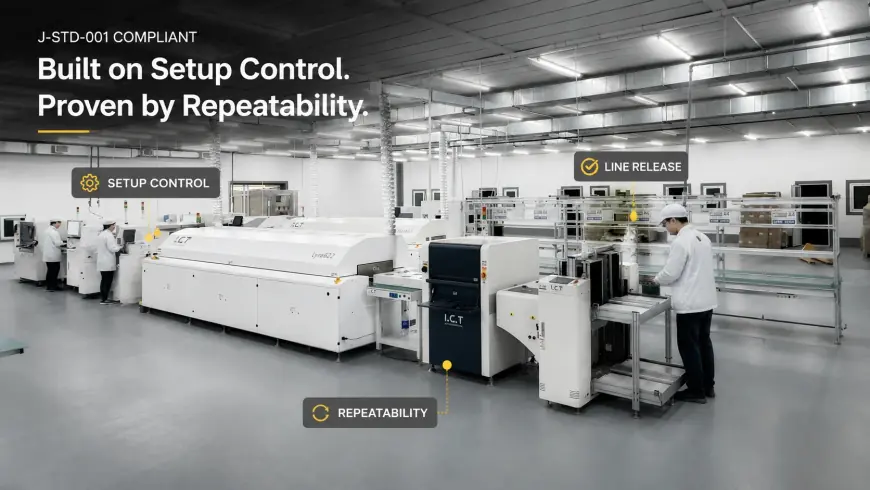


Many manufacturers believe that once a reflow oven is installed, achieving stable soldering is simply a matter of selecting the correct temperature profile. In reality, consistent solder joint quality depends on much more than oven settings. It requires careful preparation, process verification, operator training, and coordination across the entire SMT production line.
This idea is closely aligned with the principles explained in the IPC J-STD-001 reflow soldering guide, which emphasizes process control as the foundation of reliable electronics manufacturing.
A recent project completed by I.C.T in Mexico demonstrates how these principles are applied in practice.
The Customer manufactures beauty electronics, where product quality and long-term reliability are essential. To prepare the factory for production, I.C.T engineers traveled onsite to support the installation, commissioning, process verification, and operator training of a complete SMT and DIP production line.

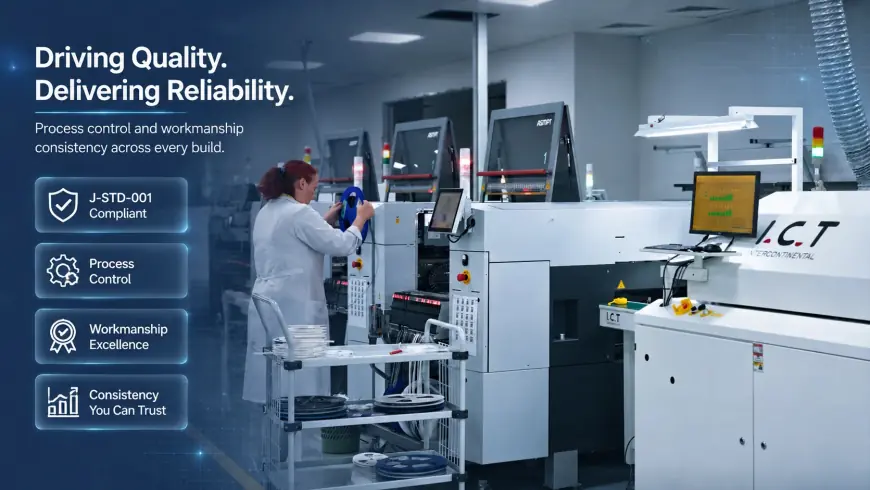
Rather than focusing on a single machine, the engineering team evaluated the entire production process.
The work began with verifying the line layout and confirming that every machine communicated correctly throughout the production flow. From solder paste printing and component placement to reflow soldering, AOI inspection, DIP assembly, wave soldering, and final functional testing, each process needed to work together before production could begin.
One of the most important tasks was establishing a suitable reflow process.
Different PCB designs respond differently to heat. Board thickness, copper distribution, component density, package types, and solder paste characteristics all influence how thermal energy is transferred during reflow soldering. Because of these variables, engineers developed and verified process parameters based on the Customer's actual products rather than relying on generic temperature settings.
Repeated trial production allowed the team to evaluate solder joint quality, identify opportunities for adjustment, and confirm that the process was suitable for continued manufacturing.
Inspection also played an important role.
SPI helped verify solder paste consistency before placement.
AOI was used to examine solder joints after reflow.
Functional testing provided another level of production verification.
Together, these processes created a complete quality control loop that supported stable manufacturing instead of relying on final inspection alone.
Operator training was another major focus of the project.
Engineers worked directly with the Customer's production team, explaining not only how to operate the equipment but also why different process parameters are required for different products. Training covered routine equipment maintenance, recipe management, basic troubleshooting, and the identification of common soldering defects that operators may encounter during daily production.
This knowledge helps production teams respond more effectively when product changes occur in the future.
Another valuable lesson from the project is that successful SMT production depends on preparation before mass production begins.
Installing machines is only the first milestone.
Before production starts, manufacturers should verify process stability, optimize equipment settings, train operators, confirm inspection programs, and validate production recipes under real manufacturing conditions.
These activities reduce unnecessary downtime and help establish a more stable production environment from the beginning.
As electronic products continue to become smaller and more sophisticated, manufacturers increasingly recognize that consistent quality depends on engineering expertise as much as equipment capability.
A reliable SMT factory is built through standardized processes, experienced engineers, and continuous improvement—not simply by purchasing advanced machines.
For companies planning a new SMT production line or expanding existing manufacturing capacity, investing time in process preparation will often produce greater long-term value than focusing on equipment specifications alone.
Reliable soldering begins with a reliable manufacturing system.
Contact: market@smt11.com
Reward this post with your reaction or TipDrop:
 Like
0
Like
0
 Dislike
0
Dislike
0
 Love
0
Love
0
 Funny
0
Funny
0
 TipDrop
0
TipDrop
0
 Sad
0
Sad
0
 Angry
0
Angry
0
















Comments (0)