



NVIDIA at the World Economic Forum Davos: Vision for AI as the Largest Infrastructure Buildout in Human History
Jensen Huang and Larry Fink’s discussion at the World Economic Forum explored how AI is driving the largest infrastructure buildout in history, reshaping global industries and accelerating workforce transformation.
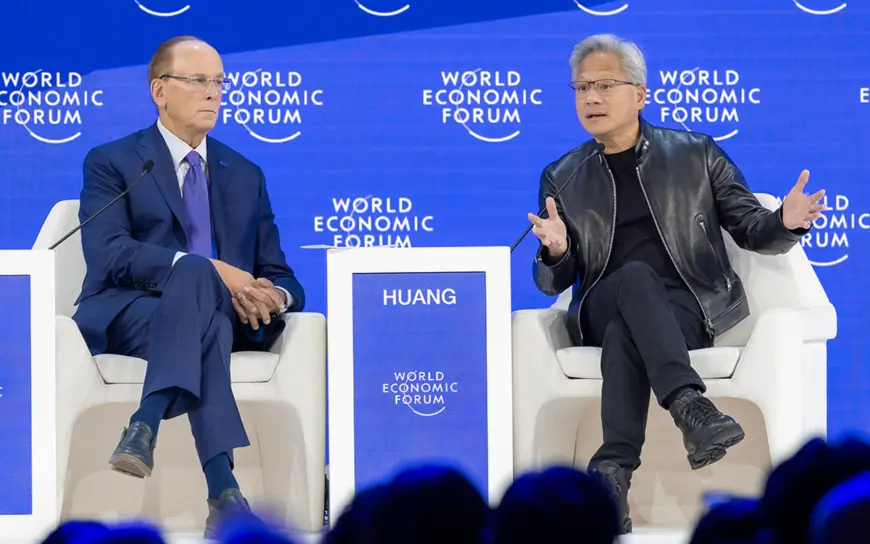


At the World Economic Forum in Davos, NVIDIA CEO Jensen Huang delivered a powerful message: artificial intelligence represents the largest infrastructure buildout humanity has ever undertaken. Speaking alongside BlackRock CEO Larry Fink, Huang emphasized that AI is not a single technology but a multi‑layered platform reshaping global economies, industries, and national strategies.
The Five-Layer AI Stack: A New Global Computing Platform
Huang described AI as a “five-layer cake” composed of energy, semiconductor manufacturing, computing infrastructure, cloud data centers, AI models, and the application layer. Each layer requires massive investment, specialized talent, and long-term development, creating a worldwide economic ripple effect across construction, manufacturing, cloud operations, and software innovation.
AI as a Driver of Job Creation and Workforce Expansion
Addressing concerns about automation, Huang argued that AI increases productivity and expands—not reduces—employment opportunities. He highlighted fields like radiology and nursing, where AI accelerates administrative tasks, allowing professionals to focus more on patient care. As efficiency rises, demand for skilled workers grows.
Record Venture Capital Investment in AI-Native Companies
Huang noted that global venture capital investment surpassed $100 billion, with AI-native startups receiving the majority of funding. These companies are building the application layer of the AI stack, driving breakthroughs in healthcare, robotics, manufacturing, and financial services.
AI as Essential National Infrastructure
Huang urged governments to treat AI as critical infrastructure, comparable to electricity or transportation systems. He emphasized the importance of developing sovereign AI models tailored to national languages, cultures, and priorities, ensuring that countries maintain control over their technological futures.
Closing the Global Technology Divide
AI’s accessibility and scalability make it a powerful equalizer. Huang explained that developing nations can leapfrog traditional infrastructure limitations by adopting AI-driven tools, accelerating economic growth and reducing global disparities.
Europe’s Strategic Advantage in the Era of Physical AI
Huang highlighted Europe’s strong industrial base as a major advantage in the emerging era of physical AI and robotics. He emphasized that “you don’t write AI—you teach AI,” underscoring the importance of combining manufacturing strength with advanced machine learning.
Investment Outlook: The Risk Is Underinvesting, Not Overinvesting
Larry Fink concluded that the world is not experiencing an AI bubble. Instead, the greater risk lies in underinvesting in AI infrastructure. He stressed that pension funds and everyday savers must participate in AI-driven growth to avoid being left behind.
A Global Call to Build the Future of AI
Huang closed with a clear message: the AI revolution requires massive, coordinated investment across all layers of the stack. The opportunity is “extraordinary,” and every sector—from energy to healthcare—must prepare for a world where AI becomes foundational to economic progress.
Reward this post with your reaction or TipDrop:
 Like
0
Like
0
 Dislike
0
Dislike
0
 Love
0
Love
0
 Funny
0
Funny
0
 TipDrop
0
TipDrop
0
 Sad
0
Sad
0
 Angry
0
Angry
0

NVIDIA pioneered accelerated computing to tackle challenges no one else can solve. Our work in AI and the metaverse is transforming the world's largest industries and profoundly impacting society.














Comments (0)