

NVIDIA multi-agent AI blueprints for intelligent warehouses and retail catalog enrichment
AI blueprints from NVIDIA transform warehouses and retail catalogs with multi-agent automation, real-time intelligence, and enriched product data at scale.
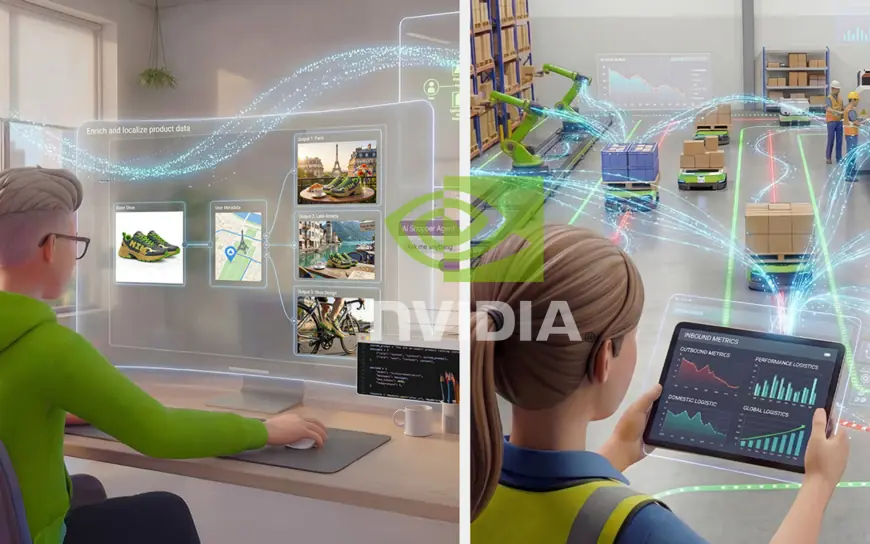


NVIDIA is introducing a new generation of multi-agent AI blueprints that connect the physical and digital sides of retail. These blueprints focus on two critical domains: the Multi-Agent Intelligent Warehouse (MAIW) and Retail Catalog Enrichment. Together, they help retailers and logistics providers orchestrate complex warehouse operations, enrich product data at scale, and deliver faster, more accurate, and more personalized shopping experiences.
What is the multi-agent intelligent warehouse blueprint?
The Multi-Agent Intelligent Warehouse (MAIW) blueprint is an AI-powered coordination layer that sits on top of existing warehouse systems such as WMS, ERP, robotics platforms, and IoT infrastructure. Instead of replacing current tools, it connects them through a multi-agent architecture, where specialized AI agents collaborate to monitor operations, optimize workflows, and respond to real-time events in natural language.
Built on the NVIDIA AI Enterprise software platform, MAIW leverages components such as NVIDIA NIM for inference microservices, NVIDIA NeMo for large language models, and GPU-accelerated libraries like cuML and cuVS for machine learning and vector search. Orchestration frameworks such as LangGraph and Model Context Protocol (MCP) enable multiple agents to share context, call tools, and reason over structured and unstructured data.
How the intelligent warehouse multi-agent system works
In the MAIW blueprint, different AI agents are responsible for specific domains—such as equipment operations, workforce coordination, safety and compliance, forecasting, and document intelligence. These agents can:
- Ingest and analyze data from WMS, ERP, sensors, cameras, and robotics systems.
- Monitor real-time events like equipment downtime, congestion, or safety incidents.
- Recommend actions such as rerouting tasks, reallocating labor, or adjusting pick paths.
- Answer natural language questions from supervisors and operators about status, performance, and root causes.
A key enabler is retrieval-augmented generation (RAG) with GPU-accelerated vector search. This allows agents to ground their responses in live operational data, historical logs, manuals, and policies, ensuring that recommendations are both explainable and aligned with real-world constraints.
Business benefits of the multi-agent intelligent warehouse
By deploying the MAIW blueprint, organizations can transform warehouses from reactive, siloed environments into proactive, AI-orchestrated operations. Typical benefits include:
- Higher throughput: Optimized task assignment, routing, and resource utilization reduce bottlenecks and idle time.
- Reduced errors and rework: AI agents continuously check for anomalies and inconsistencies in orders, inventory, and workflows.
- Improved safety and compliance: Real-time monitoring of safety rules, equipment status, and incident patterns.
- Faster decision-making: Supervisors can query the system in natural language instead of manually pulling reports.
- Better use of existing systems: The blueprint augments current WMS/ERP/robotics investments rather than replacing them.
Retail catalog enrichment blueprint: turning raw product data into rich experiences
On the digital side of retail, NVIDIA’s Retail Catalog Enrichment blueprint tackles a different but equally critical challenge: incomplete, inconsistent, and low-quality product data. Many retailers receive sparse product feeds—often just a title, SKU, and a single image—making it difficult to power search, recommendations, and engaging product detail pages.
The catalog enrichment blueprint uses multimodal generative AI to transform basic inputs into rich, structured, and localized product content. It can analyze product images, short descriptions, and existing metadata to generate:
- Detailed product descriptions tailored to brand voice and category best practices.
- Attribute extraction (size, color, material, style, use case, etc.) from images and text.
- Accurate categorization and taxonomy mapping for large product catalogs.
- SEO-optimized titles and bullet points that improve search visibility and conversion.
- Localized content for different languages and regions, while preserving brand consistency.
How the catalog enrichment blueprint works under the hood
The blueprint combines vision models and language models running on NVIDIA GPUs to understand both product imagery and text. Using RAG and vector search, it can reference brand guidelines, category rules, and regulatory constraints to ensure that generated content is accurate and compliant. Retailers can integrate the blueprint into existing product information management (PIM) systems, e-commerce platforms, and content pipelines through APIs and microservices.
Because the system is configurable and extensible, teams can define custom attributes, taxonomies, and style guides. This makes it suitable for a wide range of verticals—from fashion and electronics to home improvement, grocery, and B2B catalogs.
End-to-end impact: connecting warehouse intelligence with enriched catalogs
When the Multi-Agent Intelligent Warehouse and Retail Catalog Enrichment blueprints are used together, retailers gain an end-to-end AI fabric that spans physical operations and digital experiences. Inventory accuracy and real-time availability from the warehouse can feed directly into enriched product pages, while better product data improves demand forecasting and warehouse planning.
This closed loop enables:
- More reliable promises on delivery dates and stock levels.
- Higher conversion rates thanks to richer, more informative product content.
- Reduced returns as customers better understand products before purchasing.
- Smarter planning by aligning catalog performance data with warehouse operations and supply chain signals.
Why these NVIDIA AI blueprints matter for the future of retail
Retailers and logistics providers are under pressure to handle growing product assortments, rising customer expectations, and increasingly complex supply chains. NVIDIA’s multi-agent AI blueprints provide a practical, production-ready path to modernize both warehouse operations and digital catalogs without starting from scratch.
By combining GPU-accelerated AI, multi-agent orchestration, and retrieval-augmented generation, these blueprints help organizations move from siloed, manual workflows to connected, intelligent systems that learn and improve over time. For retailers looking to differentiate on speed, accuracy, and experience, they offer a powerful foundation for the next era of AI-driven commerce.
Reward this post with your reaction or TipDrop:
 Like
0
Like
0
 Dislike
0
Dislike
0
 Love
0
Love
0
 Funny
0
Funny
0
 TipDrop
0
TipDrop
0
 Sad
0
Sad
0
 Angry
0
Angry
0
NVIDIA pioneered accelerated computing to tackle challenges no one else can solve. Our work in AI and the metaverse is transforming the world's largest industries and profoundly impacting society.














Comments (0)