



The next generation’s guide to the new space economy
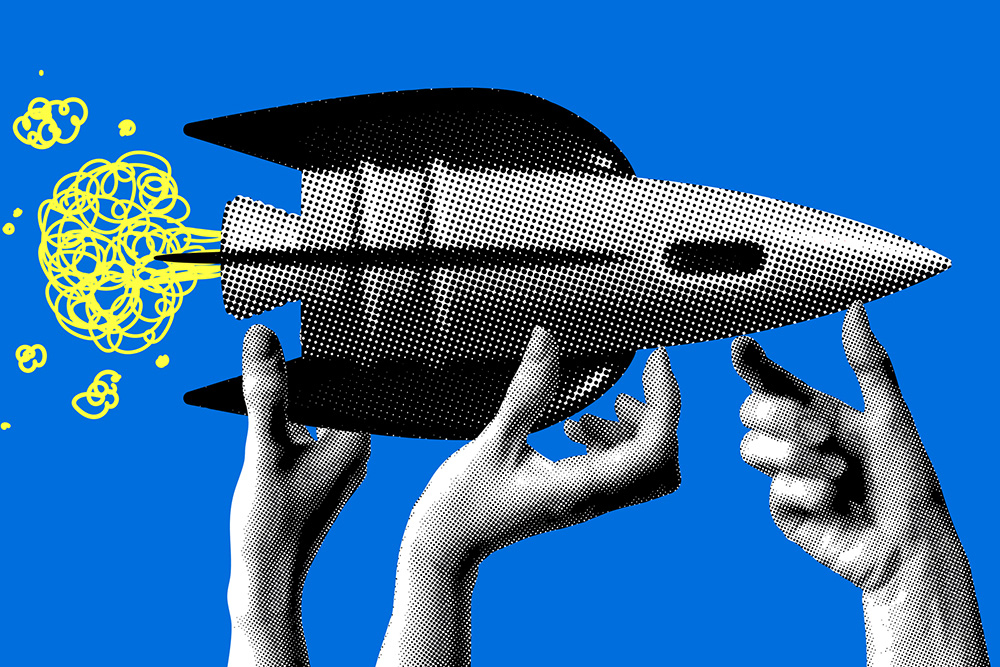


On the first day of class 16.445J/STS.468J (Entrepreneurship in Aerospace and Mobility Systems), David Mindell, MIT professor of aeronautics and astronautics (AeroAstro) and the Frances and David Dibner Professor of the History of Engineering and Manufacturing, asked his students to take a look at an image of a textbook. The cover featured a bright and inspiring collage of rockets, planets, and all manner of futuristic air- and spacecraft. The title: “Entrepreneurship in Aerospace: A Guide for Founders and Investors.”
“This is the most up-to-date guide on the topic,” Mindell said, describing the book’s treatment of the concepts and procedures involved in innovating in aerospace, an industry experiencing a renaissance of entrepreneurship led by venture-backed startups and rapid innovation, and one that, whether or not we realize it, we all depend on every day.
Konark Chopra, a graduate student in MIT’s Leaders for Global Operations Program, raised his hand. “Sounds great — how can we get a copy?”
“It doesn’t exist,” replied Mindell. “You’re going to write it this semester.”
After conducting over 50 interviews with founders, operators, engineers, and investors across the aerospace industry, the class pulled it off. The 100-page industry report, titled “Entrepreneurship in Aerospace,” provides comprehensive insight into what it actually takes to build an aerospace venture today, and makes predictions about what is needed in the near future.
The challenge to produce the report was inspired by the bestselling guide “Disciplined Entrepreneurship: 24 Steps to a Successful Startup,” by Bill Aulet, professor of the practice in the MIT Sloan School of Management and managing director of the Martin Trust Center for Entrepreneurship. Originally published in 2013, the book provides an outline for entrepreneurs in any industry to cultivate skills for success. “Entrepreneurship in Aerospace” builds on Aulet’s framework to provide an industry-specific guide. “Aerospace is its own special industry with a unique set of constraints and aspirations,” says Mindell.
“Putting together this report let the students learn what they won’t get from a regular class about aerospace entrepreneurship,” he says. “This is the view of the industry from the young people building its future. I’m incredibly proud of what they’ve accomplished.”
Betting on the known unknowns
During spring 2026, while the class was in session, major developments were shaping the aerospace sector, from NASA’s Artemis II mission to SpaceX’s launch of what would become the largest initial public offering in history. “The entire industry landscape shifted like crazy during the semester,” says Mindell, as just one of the reasons that the report was especially timely.
The report argues that the volume of capital, talent, and policy attention directed toward aerospace is “structurally different from any prior point in the industry’s history,” creating a pivotal moment for the next generation of entrepreneurs and investors.
The report further outlines five predictions about the new space economy: terrestrial infrastructure for compute, manufacturing, and energy will move off-world; autonomous systems, robots, and humans will continue to work together, but with humans in a supervisory capacity; venture capital investment will run ahead of economic justifications; government investment will become the fastest way for young companies to fundraise; and that we are years away from a global regulatory framework for space companies to operate within. Each prediction, or “bet,” includes a section on “where serious people disagree,” laying out relevant counterarguments to their conclusions.
As a guide, the report also translates its findings into practical tools, including a diagnostic for determining how many independent breakthroughs a company needs to succeed. “One of my favorite tools from the report is the miracle count,” says Chopra. “If your company needs one breakthrough to work, that’s a venture bet. If it needs three, that’s a research project pretending to be a startup.”
The report’s findings were informed both by existing research and by interviews with current aerospace professionals. Students were graded, in part, on how many people they spoke with. Their interviews focused on what excites people about the industry, reasons for their optimism (or pessimism), and how people are working within their organizations to address the challenges they see.
The experience also allowed the students to expand their professional networks, practicing a core entrepreneurial skill while gaining insider perspectives.
“We sought out people from different corners of aerospace and were always asking, ‘Who else should we talk to?’” says Nicole Lee, a graduate student in AeroAstro. “Not only was I able to reconnect with people in my own network, but I got to introduce classmates to those contacts, and then benefit from the networks they brought in, too. That exchange was a big part of what made the interview process, and the class, so special.”
Engineers as entrepreneurs
The report’s authors — 16 classmates from the Department of Aeronautics and Astronautics, MIT Sloan School of Management, and Wellesley College — bring a range of academic backgrounds and career ambitions to the project, using those different perspectives to connect the realities of aerospace engineering with the economic forces impacting the industry. Their research interests and experiences range from spacecraft propulsion and human spaceflight to investment banking and military operations. Collectively, they have worked across organizations like NASA, SpaceX, Blue Origin, Boeing, and a range of startups.
“What I’ll remember most is the team,” says Chopra. “Everyone showed up with their own wisdom and a willingness to challenge each other, learn from each other, and simply have fun. Those are the teams we hope to keep building with.”
For Lee, those industry experiences support the report’s predictions about where the field itself is headed. “Entrepreneurship in space is going to involve a much broader group of founders, engineers, researchers, policymakers, and operators,” says Lee. “Everyone working in space can take something away from understanding the entrepreneurial mindset and the cultural shift we’re seeing in commercial space. A much wider range of people will be shaping entrepreneurship in the future. I think that shift has already started with us.”
Mindell sees value in that entrepreneurial mindset, regardless of whether the students go on to found companies of their own. “I don’t know if every student in this class is going to found their own company, and I don’t expect them to, but I do expect them to drive their own careers forward,” he says. “And I think for the moment we’re at, providing that opportunity is the best thing MIT can be doing for our students.”
For Chopra, who has had his sights set on founding an aerospace company for as long as he can remember, the findings from the report are immediately applicable. “The heart of a business, a sustainable business, is the demand. What do the customers want? Sure, I could build cool technology, but if we don’t have anyone buying it, it’s a project, not a company.”
Now armed with a clear and evidence-backed picture of the landscape, Chopra wants the report to generate even more activity across the industry. “If our industry report inspires one person to go out and found a company, or invest in a company, or even think about entrepreneurship in aerospace, it’s a pretty big win.”
Reward this post with your reaction or TipDrop:
 Like
0
Like
0
 Dislike
0
Dislike
0
 Love
0
Love
0
 Funny
0
Funny
0
 TipDrop
0
TipDrop
0
 Sad
0
Sad
0
 Angry
0
Angry
0

MIT: Massachusetts Institute of Technology. The MIT community is driven by a shared purpose: to make a better world through education, research, and innovation. We are fun and quirky, inventive and artistic, obsessed with numbers, and welcoming to talented people regardless of where they come from.















Comments (0)