



How I Choose the Right Ceiling Fan With Light Size for a Room
A Nebola product manager explains how room size, ceiling height, airflow, lighting, and fixture depth work together when choosing a ceiling fan with light.
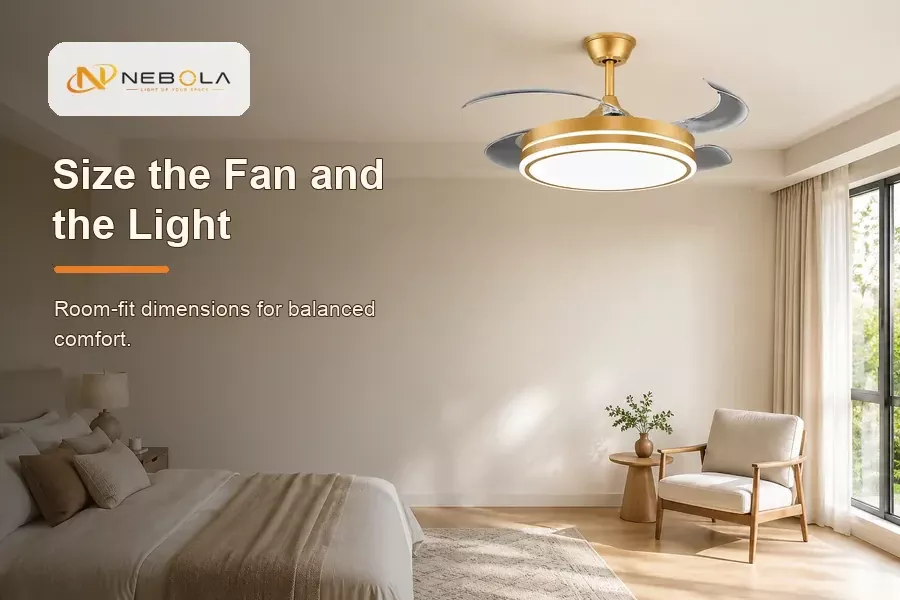


The funny thing about ceiling fan size is that the number everyone notices first is often the one that causes the most confusion.
I work on ceiling fan light product planning at Nebola, and one question comes up again and again: “What size should I choose for this room?” My answer is rarely just “42 inch” or “52 inch.” I usually start with a practical ceiling fan sizing guide, then look at ceiling height, airflow zone, lighting needs, and how the fixture will look overhead.
Why Blade Span Is Only the Starting Point
A ceiling fan with light has two jobs: move air comfortably and provide useful lighting.
So blade span matters, but so do the motor housing, LED diffuser, fixture depth, total drop, and visual weight. Two fan lights with similar blade spans can feel completely different in the same room.
A deep light body may make a compact fan feel bulky on a low ceiling. A small light module may look tidy in a large living room but leave the main seating area underlit.
From a product manager’s point of view, “Does it fit?” means more than “Will the blades clear the wall?”
I Start With How the Room Is Used
Room size gives me a direction. Room function tells me whether that direction makes sense.
Small Rooms
For compact bedrooms or home offices, roughly 20 to 36 inches can be a useful starting range. I pay extra attention to low-profile depth, quiet low-speed operation, and comfortable light.
Bedrooms and Living Rooms
Standard bedrooms often fall around 36 to 48 inches, while many living rooms move into the 48 to 56 inch range.
But I still check the active zone. Where is the bed? Where is the sofa? Is the ceiling point centered over where people spend time? A fan can be centered in the room and still be poorly positioned for daily comfort.
Large and Open Spaces
For larger rooms and open layouts, 56 inches and above may make more sense. Still, bigger is not automatically better.
Sometimes one larger fan works well. Sometimes two smaller fan lights serve separate zones more naturally. It depends on how air and light need to travel through the space.
Ceiling Height Can Change the Decision Fast
The light diffuser is often the lowest part of a fan light, so total installed height matters.
In a low room, a flush or low-profile design can feel more comfortable. In a taller room, a downrod may place the fan closer to the occupied zone.
Before approving a model, I want the total drop — not just the blade diameter.
Airflow and Lighting Need to Agree
CFM is useful, but I would never choose a fan light from CFM alone. Blade span, motor control, mounting height, room layout, and low-speed behavior all affect real comfort.
Lighting deserves the same attention. A wider diffuser does not automatically mean better light. In bedrooms, glare control can matter more than maximum brightness. In kitchens and offices, the fan light may handle general lighting while other fixtures cover task areas.
Our more detailed room-by-room fan light sizing guide explains why these elements should be judged together rather than as separate specifications.
What I Look for at Nebola
When we review a ceiling fan light concept, I think about the product system: quiet operation, efficient motor design, lighting comfort, control options, fixture depth, and the visual balance between blades and the center light body.
Depending on the market and project, we may also evaluate smart controls, modern styling, and OEM/ODM configurations.
That is why I prefer asking buyers for room dimensions and use cases before jumping straight to a model number.
One Last Check Before Choosing
Before choosing, check room dimensions, ceiling height, blade clearance, total fixture drop, airflow at normal speeds, light spread, and where people spend time.
If those pieces work together, the fan light usually feels natural once installed.
If you are planning a ceiling fan light range and want to compare sizes, functions, or OEM/ODM directions, contact our team at info@nebolafan.com. We can review the application first and work backward to the right product direction.
Ceiling Fan With Light Size FAQs
Reward this post with your reaction or TipDrop:
 Like
0
Like
0
 Dislike
0
Dislike
0
 Love
0
Love
0
 Funny
0
Funny
0
 TipDrop
0
TipDrop
0
 Sad
0
Sad
0
 Angry
0
Angry
0

I work around ceiling fan lights and home lighting, with a particular interest in product design, airflow performance, DC motor technology, and practical applications. I use this space to share things I learn from the industry — including ceiling fan sizing, CFM, blade design, energy efficiency, smart controls, lighting integration, and common mistakes when choosing a fan. I’m also interested in how manufacturers, brands, and sourcing teams approach product development and customization. The goal here is simple: share useful information and practical observations about ceiling fans and lighting, rather than just talking about products.













Comments (0)