



Ceiling Fan Size by Ceiling Height: A Designer’s Guide to Better Proportions
Choosing the right ceiling fan size means balancing ceiling height, room proportions, airflow, mounting style, lighting depth, and everyday comfort in real spaces.
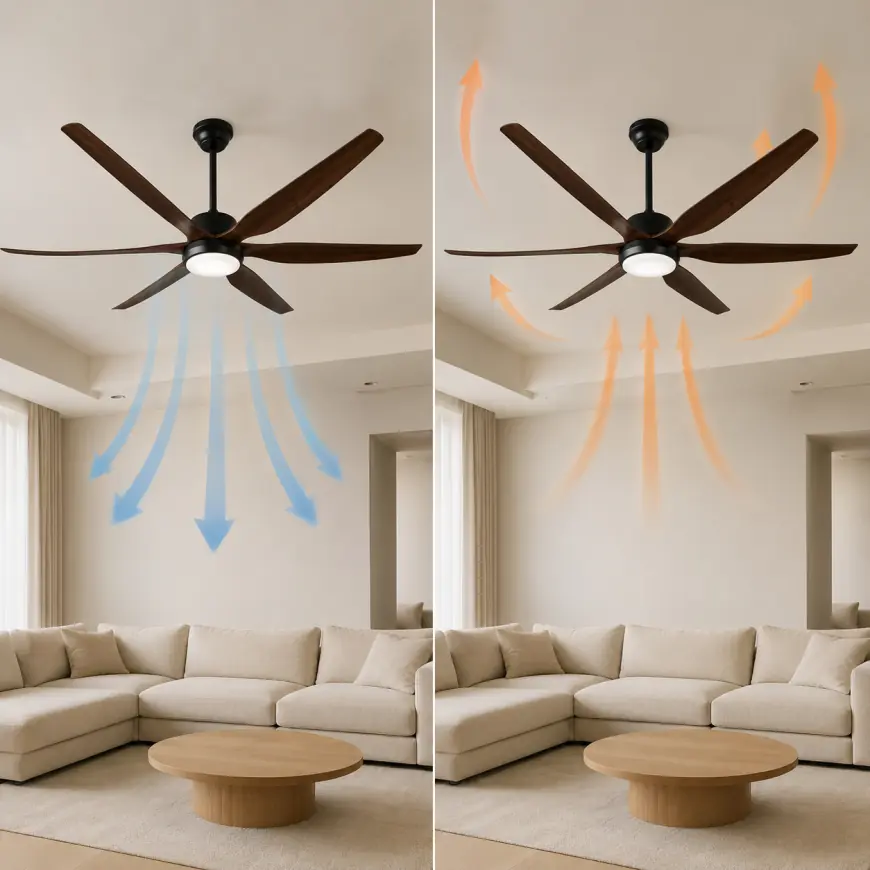


Ceiling Fan Size by Ceiling Height: A Designer’s Guide to Better Proportions
When I plan a room, I usually notice ceiling height before I notice the fan.
That may sound backwards, but the ceiling tells me what kind of visual weight the room can handle, how low a fixture can hang, and whether a large ceiling fan will feel balanced or overwhelming.
That is why choosing a fan should start with more than room width. A useful ceiling fan sizing guide should connect blade span with ceiling height, mounting style, airflow, furniture placement, and even the depth of the light itself.
Low Ceilings Need Restraint, Not Drama
In compact bedrooms, studies, apartments, and smaller kitchens, a fan can dominate the ceiling surprisingly quickly.
36–42 Inches Often Feels More Natural
For lower ceilings, 36- to 42-inch fans are often easier to integrate visually. I also tend to prefer flush-mount or low-profile designs because they keep the blades and light closer to the ceiling.
This helps preserve clearance while making the room feel less crowded.
The light matters too. A deep decorative shade may look attractive in a showroom, but in a low room it can make the entire fixture feel heavy. A slimmer LED section usually works better with clean, modern interiors.
This is where Nebola’s ceiling fan light approach fits well. Quiet DC motor options, integrated LED lighting, multiple speed settings, energy-efficient operation, and remote or smart controls can all be combined without making the ceiling look unnecessarily busy.
Standard 8–9 Foot Ceilings Give You More Freedom
Standard ceiling heights are much easier to work with.
For many bedrooms, dining rooms, and living rooms, fans in the 44- to 52-inch range can work comfortably depending on room size and layout.
A 44-inch fan may feel right in a smaller bedroom, while a 52-inch model can suit a medium living room or larger sleeping area.
Diameter Is Only Half the Story
I always check the total installed drop.
The canopy, motor housing, blades, downrod, and light all contribute to the final height. Two 52-inch fans can feel completely different once installed if one has a slim body and the other uses a deeper decorative light.
Room shape matters as well.
A long, narrow room can have the same floor area as a square room but still need a different airflow solution. Wardrobes, beams, tall cabinets, bunk beds, and furniture placement can all change how a fan fits the space.
High Ceilings Do Not Automatically Need Huge Fans
This is where people often overcorrect.
A high ceiling does not automatically mean choosing the largest blade span available.
Sometimes the Downrod Is More Important
If the fan is mounted too high, much of the airflow may remain above the area where people actually sit, dine, or relax.
In that situation, selecting the right downrod can be more useful than simply increasing the fan diameter.
This practical guide to matching fan size with ceiling height explains how blade span, downrod length, mounting height, clearance, and airflow work together.
For larger family rooms and open-plan spaces, 56- to 60-inch fans can make sense. But I would still compare motor performance, CFM, blade shape, and actual mounting height before deciding.
For a very long space, two properly positioned fans may even create a more balanced result than one oversized fan in the center.
Good Design Is About Proportion and Comfort
From an interior designer’s point of view, the best ceiling fan is not simply the widest one or the one with the most impressive specifications.
It should look as if it belongs in the room.
That means balancing ceiling height, fan diameter, body depth, lighting, furniture scale, and visual style. Quiet operation and energy-efficient DC motors matter too, because a ceiling fan becomes part of everyday life rather than just part of the décor.
Nebola develops modern Ceiling Fan Light solutions with quiet operation, efficient DC motor options, lighting integration, smart controls, and different installation structures.
For brands, distributors, developers, and project buyers, Nebola also supports OEM/ODM development across different blade spans, mounting structures, finishes, lighting configurations, and control options.
If you are planning a ceiling fan light range or selecting products for a residential, hospitality, or commercial project, contact Nebola at info@nebolafan.com.
Reward this post with your reaction or TipDrop:
 Like
0
Like
0
 Dislike
0
Dislike
0
 Love
0
Love
0
 Funny
0
Funny
0
 TipDrop
0
TipDrop
0
 Sad
0
Sad
0
 Angry
0
Angry
0

I work around ceiling fan lights and home lighting, with a particular interest in product design, airflow performance, DC motor technology, and practical applications. I use this space to share things I learn from the industry — including ceiling fan sizing, CFM, blade design, energy efficiency, smart controls, lighting integration, and common mistakes when choosing a fan. I’m also interested in how manufacturers, brands, and sourcing teams approach product development and customization. The goal here is simple: share useful information and practical observations about ceiling fans and lighting, rather than just talking about products.














Comments (0)