



What Makes a Good Office Ceiling Fan? Size Is Only Part of the Answer
Learn how to choose the right office ceiling fan size based on workspace layout, ceiling height, airflow, noise, HVAC coordination and energy efficiency.
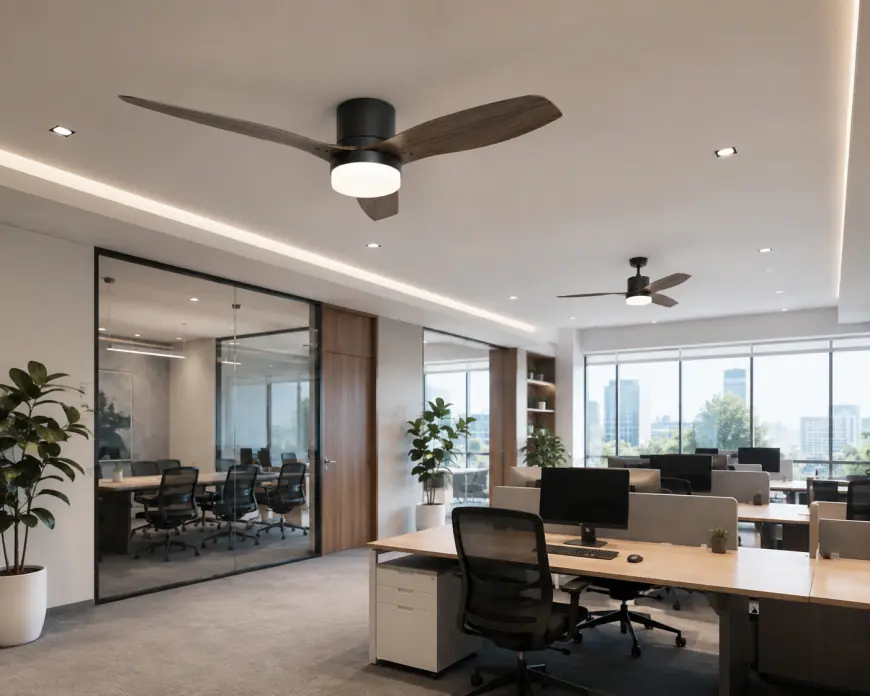



When people plan ceiling fans for an office, the conversation usually starts with a number:
36 inches?
42 inches?
52 inches?
But in real office projects, fan size is only the first decision — not the final answer.
An office ceiling fan has to work around desks, meeting tables, lighting, HVAC diffusers, ceiling height, noise expectations, and people who may sit in the same position for eight hours.
That is why I always prefer to start with a broader ceiling fan sizing reference before choosing individual models.
The goal is not to create the strongest airflow.
The goal is to create an office where nobody needs to think about the fan.
Start With the Workstations, Not the Ceiling
A perfectly centered ceiling fan can still be badly positioned.
Why?
Because people do not sit according to the geometry of the ceiling.
They sit around:
- desks,
- conference tables,
- collaborative areas,
- reception zones,
- private offices.
A small private office may work well with a 36–42 inch ceiling fan, while many standard offices and meeting rooms can use a 52 inch fan. Larger training rooms and shared workspaces may require 60 inch or larger fans, or several fans arranged around working zones instead of one oversized unit.
That distinction matters.
For a large open-plan office, three correctly positioned medium-size fans may produce a more comfortable result than one dramatic fan placed in the middle of the room.
The Best Office Fan Is Often Best at Low Speed
High-speed airflow looks impressive in a specification sheet.
But office users rarely need maximum speed all day.
They need a fan that can run quietly and smoothly at low or medium speed without:
- blowing papers across desks,
- drying someone’s eyes,
- creating vibration during calls,
- making people feel a constant draft.
This is one reason DC motor ceiling fans are increasingly practical for offices. They support multiple speed levels, quiet operation and efficient everyday use. The original workspace guide also emphasizes that low-speed comfort is often more valuable than maximum airflow in an office environment.
Ceiling Height Can Completely Change the Product Choice
A 52-inch fan may be suitable for the room area but still be wrong for the ceiling.
Low offices benefit from flush-mount or slim-profile ceiling fans because they preserve clearance and reduce visual pressure above desks.
Standard ceilings allow more flexibility.
High ceilings may need a downrod to bring the fan into a useful airflow zone. Otherwise, much of the air movement can remain too high above employees to create meaningful comfort.
This is where product depth matters almost as much as blade diameter.
A Ceiling Fan Should Support HVAC, Not Fight It
One of the easiest project mistakes is placing a ceiling fan without considering where the air-conditioning supply diffuser is located.
A fan positioned poorly around HVAC airflow can make one workstation feel cold while another still feels warm.
Ceiling fans are useful for mixing room air and reducing stagnant zones, but they do not replace ventilation, filtration, heating or air conditioning.
For a more detailed breakdown of office layouts, desk density, ceiling clearance and HVAC coordination, see this office ceiling fan planning guide.
Lighting Should Stay in the Background Too
Office ceilings already have plenty going on:
panel lights, downlights, sprinklers, air diffusers, acoustic systems and sometimes projectors.
Adding a ceiling fan light only makes sense when the lighting works with that existing plan.
For screen-based work, I prefer LED lighting that feels soft and practical rather than overly bright or decorative.
Reception areas and lounges can handle more expressive designs.
Main workspaces usually benefit from something quieter visually.
For Large Projects, Consistency Matters
If you are sourcing fans for ten, fifty or several hundred offices, choosing the “perfect” individual fan for every single room can quickly become difficult to manage.
A better purchasing strategy is often to build a controlled range:
- compact models for private offices,
- 52-inch models for standard workspaces,
- larger models for open areas,
- consistent finishes,
- compatible control systems,
- repeatable installation structures.
That makes procurement, installation, spare parts and future maintenance much easier.
This is also where NEBOLA’s OEM/ODM approach can be useful for commercial projects. Fan size, DC motor configuration, LED lighting, finish, control method and product depth can be developed around a repeatable office product family instead of sourcing unrelated models room by room.
Final Thought
A good office ceiling fan should not become the star of the room.
It should quietly solve a problem.
The room feels fresher.
Meetings stay quiet.
Energy use stays reasonable.
Employees stop thinking about airflow.
For me, that is a much better definition of performance than simply asking which fan has the biggest diameter or highest RPM.
For office, commercial or customized ceiling fan light projects, contact:
Reward this post with your reaction or TipDrop:
 Like
0
Like
0
 Dislike
0
Dislike
0
 Love
0
Love
0
 Funny
0
Funny
0
 TipDrop
0
TipDrop
0
 Sad
0
Sad
0
 Angry
0
Angry
0

A Senior Product Engineer with 8 years of experience in the ceiling fan lighting industry, specializing in ceiling fan with light systems and integrated LED lighting solutions. Extensive expertise in turning product concepts into reliable and manufacturable OEM/ODM solutions for global brands. Over 100 export projects have been delivered across North America, Europe, Australia, and the Middle East, covering residential, hospitality, and commercial applications. Core engineering experience includes flush mount ceiling fan with light systems, energy-efficient DC motor technology, remote control integration, and dimmable LED lighting design. Focus is placed on product reliability, manufacturing feasibility, and long-term performance in real-world applications.















Comments (0)