



How to Choose Lumbar Support That Actually Works With Your Office Chair
A practical guide to choosing ergonomic lumbar support based on chair fit, lumbar curve, stability, material recovery, daily office use, and whether heat or massage features are worth adding.


How to Choose Lumbar Support That Actually Works With Your Office Chair
If you spend most of your day sitting at a desk, you probably know the routine.
You start the morning sitting comfortably. A few hours later, you're shifting around, leaning forward, or trying to find that one position where your lower back finally feels supported.
Before replacing the entire office chair, take a closer look at the lumbar support.
For people comparing different posture-support products, a posture corrector cushion can be a useful starting point. The right support should work with your chair and your everyday sitting habits—not simply look thick and comfortable.
Start With the Chair You Already Have
The first question is surprisingly simple: Where is your lower back actually touching the chair?
Sit normally and lean back. If your upper back touches the backrest but there is a noticeable gap around your lower back, a shaped lumbar cushion may provide more useful support than a flat pillow.
Chair depth matters too.
A deep seat can encourage you to slide forward, which increases the distance between your lower back and the backrest. In this situation, simply adding a cushion may not solve everything. An integrated seat-and-back support design can sometimes provide better control of the sitting position.
And remember: thicker does not automatically mean better.
A cushion that is too thick may push you too far forward and change your relationship with the desk.
Look at the Shape, Not Just the Softness
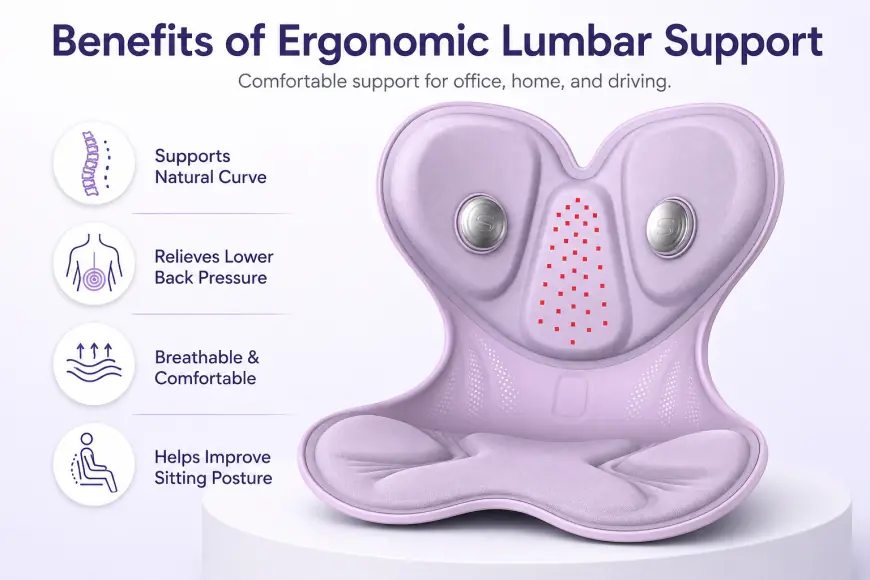
A lumbar support should meet the natural inward curve of the lower back.
If the curve sits too high, too low, or pushes too aggressively, it may feel supportive during the first few minutes but become uncomfortable during a longer work session.
This is where product geometry becomes important.
The side profile can reveal the cushion's thickness, curve height, and relationship with the chair. For B2B buyers, this is also one reason sample testing is more useful than judging a product from photographs alone.
Material recovery matters as well. Cushioning materials are repeatedly compressed during daily use, so they need to return toward their original shape. If the material quickly becomes flat, the original support structure loses much of its value.
The outer fabric also affects the experience. Breathability, softness, friction, durability and cleaning requirements can all become important during long office sessions.
Stability Is Easy to Ignore—Until It Fails
A lumbar cushion that constantly moves is not particularly helpful.
Imagine adjusting it before every meeting, reaching for your keyboard and then having it slide again. Not exactly the relaxing office experience anyone had in mind.
Depending on the design, straps, anti-slip surfaces or an integrated seat base can help maintain stability.
The chair surface matters too. Fabric, mesh, leather and other materials create different levels of friction.
A product that stays perfectly positioned on one chair may behave differently on another.
Test It Like a Real Office Worker
A five-second test tells you very little.
A better test lasts around 30 minutes.
Sit normally. Type. Read. Join a video meeting. Reach for something on your desk. Stand up and sit back down.
Then ask yourself:
-
Does the lower back remain supported?
-
Does the cushion move?
-
Does it create pressure around the thighs?
-
Does it change your keyboard position?
-
Does your desk suddenly feel too low or too far away?
-
Is the support still comfortable after the first impression disappears?
Different body types can also experience the same cushion differently. Height, torso length, hip position and chair preference all influence where the lumbar curve lands.
For brands developing ergonomic products, testing several users can provide much more useful feedback than relying on one sample user.
What About Heat and Massage?
This is where ergonomic support can move into the wellness category.
Heat can make a support product more attractive for home offices, colder environments and relaxation-focused applications. Massage can add another comfort-oriented function for users who want to relax after a long day.
But there is an important rule: the basic support should still work when the extra function is switched off.
A heated or massage-enabled product should not depend entirely on its electronic features to feel useful.
For office environments, noise and control are also worth considering. A strong massage function may not be appropriate during a video meeting or a period of concentrated work.
This is where product development needs to match the actual user scenario.
StarBright Health works with ergonomic and wellness product development, supporting areas such as support-structure planning, sample testing, comfort-function integration according to specifications, packaging and private-label OEM/ODM production.
What Should B2B Buyers Check?
If you're sourcing an ergonomic lumbar support product for a brand or distribution business, don't stop at the question, “Does it feel comfortable?”
Ask how the lumbar curve was designed.
Ask about material recovery.
Ask how stability was tested.
Ask about sample lead times and revision options.
Also discuss materials, colors, packaging, documentation and private-label requirements before moving toward mass production.
The first sample should be treated as a starting point for testing—not automatically as the final product.
For a more detailed breakdown of chair fit, lumbar geometry, materials, testing and common mistakes, see this ergonomic lumbar support selection guide.
Comfort Should Fit the Whole Workspace
A lumbar cushion doesn't work by itself.
After adding support, check your desk height, monitor position, keyboard reach and foot position again. Even a well-designed support can feel wrong if the rest of the workstation is poorly adjusted.
And don't forget movement.
Good lumbar support can make sitting more comfortable, but it shouldn't become an excuse to stay in the chair all day. Stand up, walk around, stretch and change your position throughout the workday.
For consumers, the best lumbar support is the one that fits the chair and feels natural after real use.
For brands and distributors, the best product is the one that combines ergonomic design, practical comfort, reliable construction and a supplier capable of supporting revisions before mass production.
StarBright Health provides OEM/ODM development support for ergonomic and wellness products and can be contacted at info@starbright-health.com.
Reward this post with your reaction or TipDrop:
 Like
0
Like
0
 Dislike
0
Dislike
0
 Love
0
Love
0
 Funny
0
Funny
0
 TipDrop
0
TipDrop
0
 Sad
0
Sad
0
 Angry
0
Angry
0

Hello, I'm Felix, working in the health and wellness product industry. My focus areas include massage technology, product development, OEM/ODM manufacturing, and global market trends. I collaborate with teams to develop customized wellness products for international brands, retailers, and distributors. I enjoy exploring innovative product designs, manufacturing processes, and emerging trends in personal health technology. Looking forward to connecting with professionals and sharing knowledge about wellness products and industry development.
















Comments (0)