



Garage Ceiling Fan Size: What I Wish I Knew Before Buying One
Choosing a garage ceiling fan is not just about picking the biggest model. Learn how garage size, ceiling height, clearance, airflow, motor type and lighting affect the right choice.



Garage Ceiling Fan Size: What I Wish I Knew Before Buying One
I used to think choosing a garage ceiling fan would be easy.
Measure the garage, find the biggest fan that fits, install it, and enjoy the breeze.
Well… that plan lasted about five minutes.
A garage isn't really like a bedroom or living room. Mine has a garage door track, storage shelves, a vehicle underneath, and a workbench that somehow keeps getting more crowded. Suddenly, choosing the right fan became less about the room's total square footage and more about what was actually happening underneath the ceiling.
If you're starting from scratch, this ceiling fan size guide gives a useful overview of how blade size and room dimensions work together.
The Garage Size Isn't the Whole Story
Measure where you actually spend time
The part of my garage that needs airflow most isn't necessarily the center of the room.
It might be the workbench, the area beside the car, or the corner where a home gym has slowly taken over.
That means I would check:
- The length and width of the main activity area
- Ceiling height
- Garage door tracks
- Beams and overhead lights
- Storage shelves
- Vehicle height
- Where people actually stand or work
A single-car garage may work well with a 42–52 inch fan, while a two-car garage may be better suited to a 52–60 inch model or even two smaller fans. Larger workshops can benefit from 60-inch-plus fans or multiple units, depending on the layout.
The important part is that these aren't automatic rules. The actual layout still matters.
Then I Started Looking Up
Ceiling height changes everything
My first instinct was to focus on blade diameter.
Then I looked at the ceiling.
A low garage may need a flush-mount fan to preserve clearance. A taller garage may benefit from a downrod that brings the blades closer to the area where people are working.
And there are plenty of things competing for that space: garage doors, ladders, storage racks, open vehicle doors and shelves.
A fan that technically fits the room can still be a terrible choice if the blades end up too close to something else.
Bigger Doesn't Automatically Mean Better
I care about airflow, not just blade span
A large fan sounds impressive, but blade diameter isn't the only thing controlling how comfortable the garage feels.
CFM, blade design, motor performance and mounting height all affect the result. A fan that moves plenty of air at an unnecessarily high speed may also create a dusty, uncomfortable work area.
For everyday garage use, I would rather have smooth, controllable airflow than simply maximum wind.
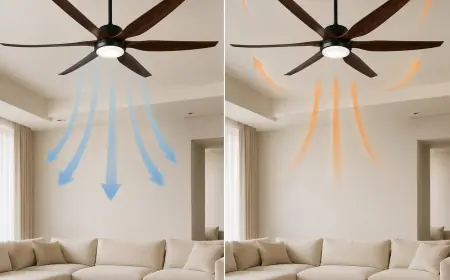
This is one reason DC motor ceiling fans are interesting. They can offer smoother speed adjustment, quieter operation and lower running costs, which can be useful when the fan runs during long weekend projects or home gym sessions.
Nebola's Ceiling Fan Light solutions follow this practical direction, combining DC motor options, quiet operation, efficient control and modern designs for different room applications.
What About a Fan With a Light?
Convenient, but don't throw away your work lights
A ceiling fan light sounds perfect for a garage because it combines airflow and general lighting in one fixture.
And honestly, I like that idea.
But I wouldn't expect the fan light to replace every light in the garage.
A workbench, tool wall or detailed repair area still needs focused task lighting. The ceiling fixture can provide general illumination while the fan keeps air moving.
For me, that's a much more practical way to think about a Ceiling Fan Light.
One Big Fan or Two Smaller Ones?
Look at the zones
A square garage may be easy to cover with one appropriately sized fan.
A long workshop is different.
If the workbench is at one end and storage or parking is at the other, two smaller fans may distribute airflow more evenly than one oversized fan trying to reach everything.
That also gives you more control over where the airflow goes.
If you're planning a garage or workshop installation, this garage ceiling fan sizing guide is worth checking before you decide on the final size.
My Simple Buying Checklist
Before buying, I'd check five things:
- Where do I actually need airflow?
- How much clearance is available?
- Is the ceiling low, standard or high?
- Do I need general lighting from the same fixture?
- Will the motor and controls be comfortable for long-term use?
And one more thing: a ceiling fan circulates air, but it isn't a substitute for proper garage ventilation when dust, fumes or vehicle exhaust are involved.
After looking at it this way, choosing a garage fan feels much less complicated.
You don't need the biggest fan.
You need the right fan for the space you actually use.
For brands, distributors or project buyers looking for customizable Ceiling Fan Light solutions, Nebola also supports OEM/ODM development based on application, design and control requirements.
For product or OEM/ODM inquiries, contact info@nebolafan.com.
Reward this post with your reaction or TipDrop:
 Like
0
Like
0
 Dislike
0
Dislike
0
 Love
0
Love
0
 Funny
0
Funny
0
 TipDrop
0
TipDrop
0
 Sad
0
Sad
0
 Angry
0
Angry
0

I work around ceiling fan lights and home lighting, with a particular interest in product design, airflow performance, DC motor technology, and practical applications. I use this space to share things I learn from the industry — including ceiling fan sizing, CFM, blade design, energy efficiency, smart controls, lighting integration, and common mistakes when choosing a fan. I’m also interested in how manufacturers, brands, and sourcing teams approach product development and customization. The goal here is simple: share useful information and practical observations about ceiling fans and lighting, rather than just talking about products.













Comments (0)