



NASA’s X-59: Ushering in the Future of Quiet Supersonic Flight
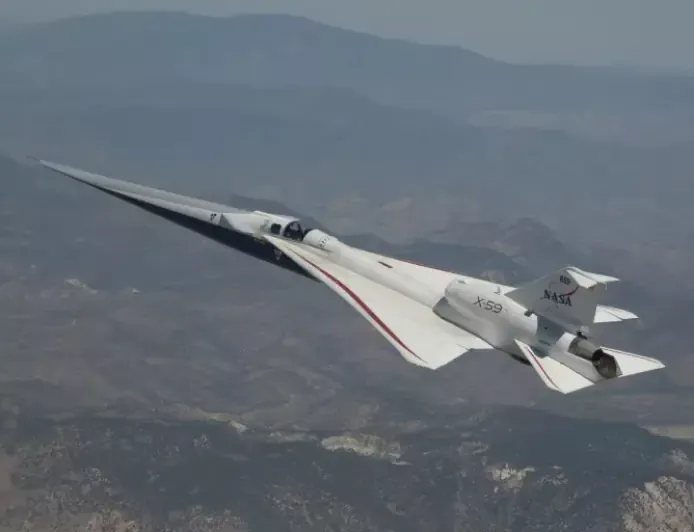


In June 2026, NASA’s X-59 experimental aircraft will attempt its first supersonic flights, marking a pivotal moment in aviation history. Designed under the Quesst mission, the X-59 aims to prove that supersonic travel can be quiet, sustainable, and acceptable for communities worldwide.
Breaking the Sound Barrier — Quietly
Highlights:
- First Supersonic Flight: Early June 2026, reaching Mach 1.4 (925 mph) at 55,000 feet.
- Ultimate Performance: Capable of Mach 1.6 (1,218 mph) and 60,000 feet.
- Innovation: Instead of a disruptive sonic boom, the X-59 is engineered to produce a gentle “sonic thump.”
This breakthrough could lift long-standing bans on overland supersonic travel, opening the skies to faster passenger flights.
Completed Flight Achievements
Milestones:
- First flight: October 2025.
- 14 flights completed since March 2026.
- Landing gear retraction test: “gear swing” successful.
- Performance: Mach 0.95 (~627 mph) and 43,000 feet reached.
- Dual-flight days: Demonstrated varied test conditions (high/fast vs. low/slow).
Cutting-Edge Technology
Systems & Design:
- Fuel, hydraulics, environmental controls: Validated successfully.
- eXternal Vision System (XVS): Cameras replace a windshield, feeding real-time visuals to cockpit monitors.
- Strain gauges: Measured structural forces during flight.
The Quesst Mission
The Quesst mission is NASA’s effort to prove that supersonic travel can be quiet enough for everyday use. Traditionally, aircraft breaking the sound barrier produce a disruptive sonic boom. The X-59 is designed to reshape shockwaves so that instead of a boom, communities hear a gentle “sonic thump.”
Mission Goals:
- Community Feedback: Collect responses on noise levels during flyovers.
- Regulatory Impact: Success could lead to new rules allowing supersonic passenger flights over land.
- Vision: Faster travel times without disturbing people on the ground.
X-59 vs Concorde: A Tale of Two Supersonic Icons
| Feature | X-59 | Concorde |
|---|---|---|
| Purpose | Research prototype | Luxury passenger jet |
| Speed | Mach 1.4–1.6 | Mach 2.04 |
| Altitude | 55,000–60,000 ft | 60,000 ft |
| Noise | Quiet “thump” (~75 dB) | Loud sonic boom (~105 dB) |
| Capacity | 1 pilot | ~100 passengers |
| Legacy | Future-focused, regulatory testing | Prestige, retired in 2003 |
Why It Matters
Impact:
- Community Flyovers: NASA will collect public feedback on noise levels.
- Regulatory Change: Success could lead to new rules allowing supersonic passenger flights over land.
- Commercial Potential: Airlines may reintroduce supersonic routes, cutting travel times in half.
The Road Ahead
The X-59 is not just about speed — it’s about reshaping the future of aviation. By proving that supersonic travel can be quiet, NASA is laying the groundwork for a new era where crossing continents in hours becomes routine, without disturbing communities below.
Reward this post with your reaction or TipDrop:
 Like
0
Like
0
 Dislike
0
Dislike
0
 Love
0
Love
0
 Funny
0
Funny
0
 TipDrop
0
TipDrop
0
 Sad
0
Sad
0
 Angry
0
Angry
0

The National Aeronautics and Space Administration is America’s civil space program and the global leader in space exploration. The agency has a diverse workforce of just under 18,000 civil servants, and works with many more U.S. contractors, academia, and international and commercial partners to explore, discover, and expand knowledge for the benefit of humanity.













Comments (0)