



Reprogrammed NK immune cells target cancer and autoimmune disorders


MIT engineers have developed a new way to program natural killer (NK) immune cells to target cancerous T cells or T cells that have become autoreactive, leading to diseases such as lymphoma and autoimmune hepatitis.
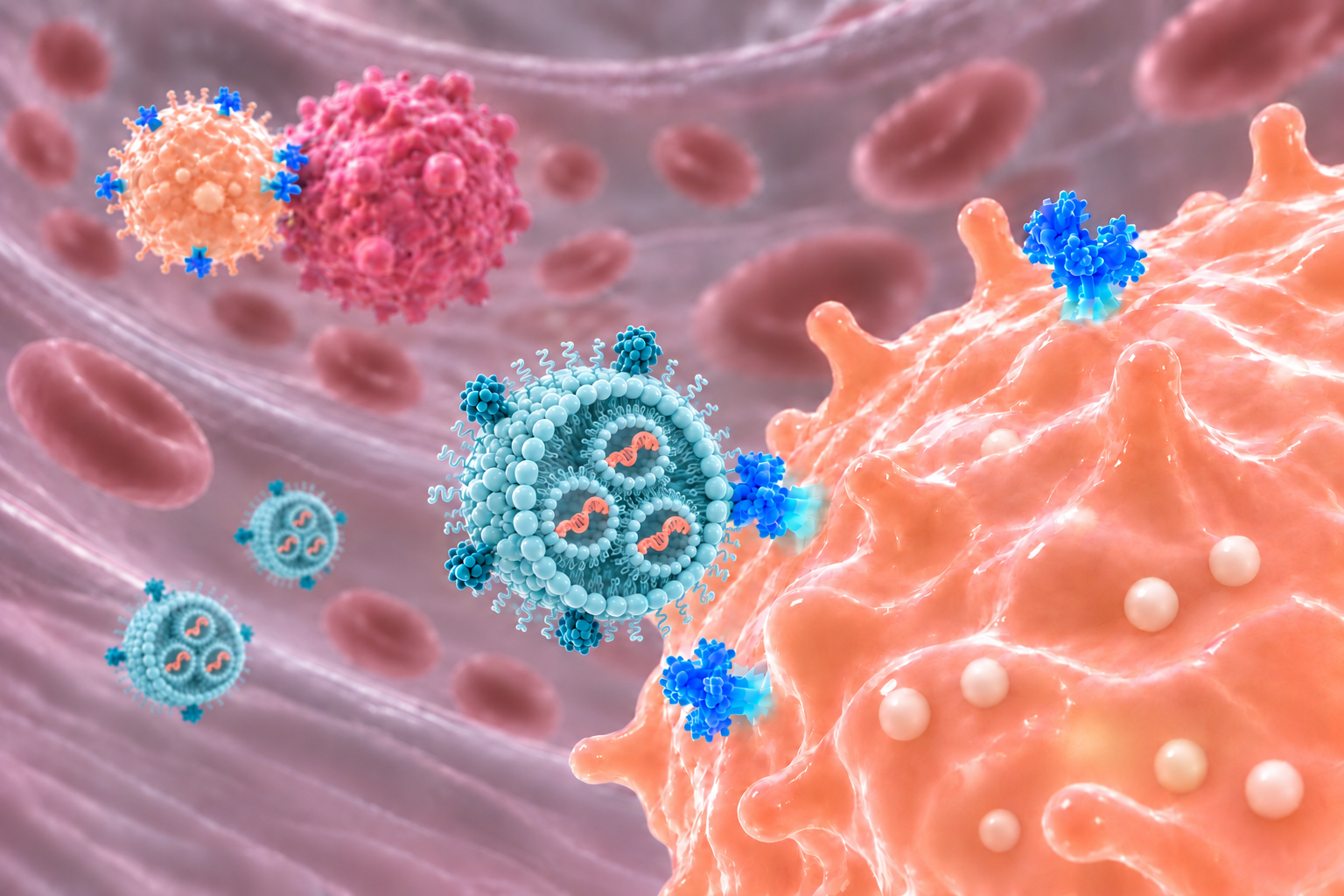
Using their new technique, the researchers can reprogram NK cells to target diseased T cells without ever removing the NK cells from the patient’s body. Instead, they use lipid nanoparticles to deliver messenger RNA directly to NK cells. These mRNA molecules encode proteins that allow the NK cells to seek and destroy the dysfunctional T cells.
Known as CAR NK cells, these cells could be deployed against a variety of diseases. The MIT team’s new approach could bypass one of the major obstacles to using these cells, which is the time and expense of manufacturing them outside the body.
“The manufacturing challenges with CAR NK cells are significant. The idea here is you can deliver a nanoparticle that will modify your own NK cells with a CAR construct and teach them to attack tumor cells,” says Daniel Anderson, a professor in MIT’s Department of Chemical Engineering and a member of MIT’s Koch Institute for Integrative Cancer Research and Institute for Medical Engineering and Science.
Anderson is the senior author of the study, which appears today in Nature Biotechnology. The paper’s lead authors are MIT postdoc Yuang Chen and MIT graduate students Julia Monkovic and Haseeb Mughal. Robert Langer, the David H. Koch Institute Professor at MIT, is also an author.
Easier reprogramming
Over the past decade, the U.S. Food and Drug Administration has approved seven new cancer treatments based on engineered T cells called chimeric antigen receptor (CAR) T cells. Chimeric antigen receptors are proteins that can be embedded into T cells, allowing them to detect a target antigen, such as a cancer protein. When the target is detected, the T cell becomes activated and destroys the target cell.
This approach has had great success in treating blood cancers, primarily those that originate from B cells, including several types of leukemia, lymphoma, and multiple myeloma.
To make CAR T cells, doctors take a blood sample from the patient. The sample is sent to a lab where the T cells are isolated and then engineered to express the CAR protein. When enough CAR T cells have been generated, they are shipped back to the hospital and infused into the patient.
In recent years, scientists have begun using a similar strategy to create CAR NK cells. One potential advantage of CAR NK cells over CAR T cells is that they could be used to kill diseased T cells. Using CAR T cells to treat T cell diseases often doesn’t work well because T cells that are engineered to target T cell proteins may end up killing each other, in addition to the diseased T cells. That issue doesn’t arise when using NK cells to target T cells.
“NK cells can treat these T cell malignancies — not only T cell cancer, but also T cell autoimmune diseases,” Chen says.
However, manufacturing large quantities of CAR NK cells poses many of the same difficulties as generating CAR T cells. To simplify the process, the MIT team wanted to come up with a way to generate CAR NK cells “in vivo” — that is, in the patient’s own body, without having to remove any cells.
“If a patient can just get an infusion of nanoparticles, it would dramatically simplify the process and reduce costs,” Anderson says.
Currently, there are no FDA-approved CAR NK cell therapies, but many researchers are working on developing them to treat cancer or autoimmune disorders.
To generate these cells, the MIT team designed lipid nanoparticles (LNPs) that can deliver an mRNA payload. These strands of mRNA encode a CAR that can be targeted to specific cell types. For example, they could deliver a CAR that targets CD19, a protein found on B cells, or CD3, a protein found on autoreactive T cells.
The particles are coated with antibody fragments that bind to receptors found on the surface of NK cells, to ensure they reach the correct targets.
Targeting dysfunctional T cells
After these particles were infused into mice, the researchers found that they could successfully reprogram about 80 percent of the targeted NK cells. The researchers then tested the particles’ potential to treat cancer and autoimmune hepatitis, which is caused by autoreactive T cells.
In a mouse model of an aggressive form of melanoma, three of the five mice that received LNPs that reprogrammed their NK cells to target the cancer cells went into complete remission.
The researchers also saw significant tumor destruction when they used the LNPs to treat T cell lymphoma in a humanized mouse model, created when mice receive transfusions of human blood cells, allowing them to transiently generate a human-like immune system.
In these mice, tumors were eradicated after five injections of the reprogramming LNPs. This result was similar to what the researchers saw when they treated mice with CAR NK cells that were generated using the conventional approach — removing NK cells, reprogramming them, and returning them to the mice.
Lastly, the researchers demonstrated that their LNPs could generate CAR NK cells that target autoreactive T cells. For this application, they studied mice with autoimmune hepatitis, in which T cells attack hepatocytes in the liver. They found that in the treated mice, the autoreactive T cells were destroyed, and liver damage healed. These effects were seen after just one injection of the LNPs.
“This study is an excellent example of the power of nano delivery systems and their ability to potentially treat cancer and other diseases,” Langer says.
The researchers hope that these kinds of engineered NK cells could be used to treat a variety of autoimmune disorders caused by dysfunctional T cells, including multiple sclerosis and rheumatoid arthritis.
The research was funded by Sanofi, the Marble Center for Cancer Nanomedicine, and a Koch Institute Support (core) Grant from the National Cancer Institute.
Reward this post with your reaction or TipDrop:
 Like
0
Like
0
 Dislike
0
Dislike
0
 Love
0
Love
0
 Funny
0
Funny
0
 TipDrop
0
TipDrop
0
 Sad
0
Sad
0
 Angry
0
Angry
0

MIT: Massachusetts Institute of Technology. The MIT community is driven by a shared purpose: to make a better world through education, research, and innovation. We are fun and quirky, inventive and artistic, obsessed with numbers, and welcoming to talented people regardless of where they come from.
















Comments (0)