



Vidu Q4: Text to Video and Image to Video for Practical Production Workflows
Vidu Q4 turns written briefs and still frames into coherent moving shots. A practical look at prompting, motion consistency, image to video workflows, and where the model fits in a real production pipeline.

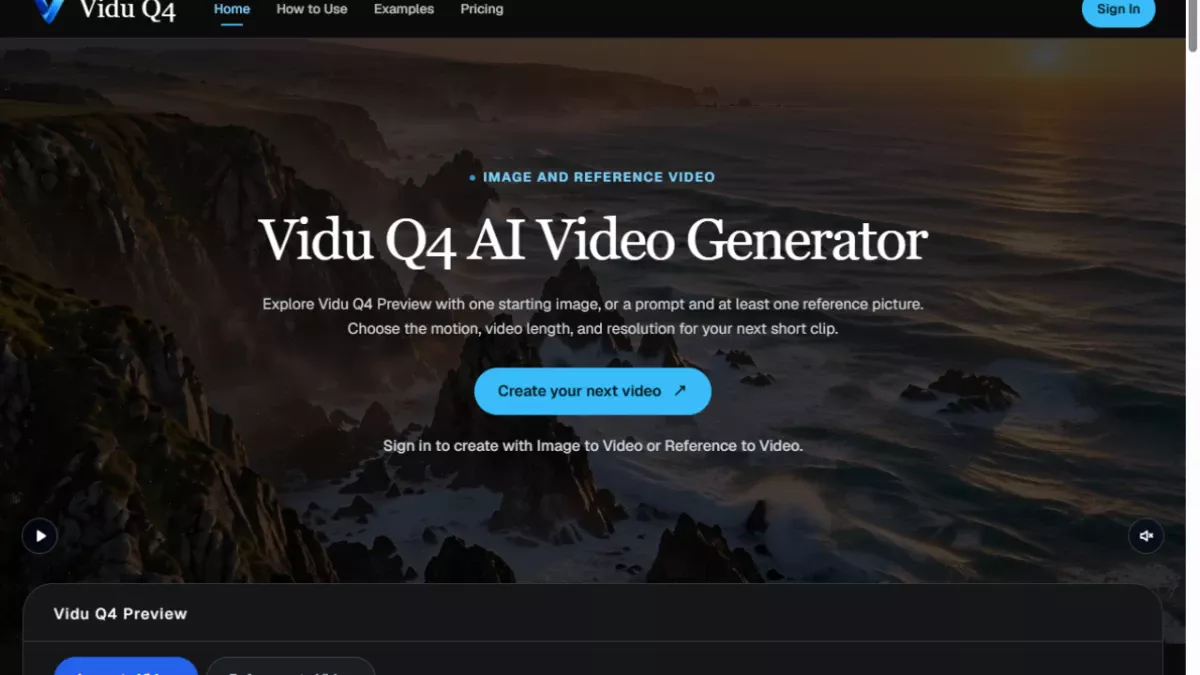


Video generation has moved past the novelty stage and into something production teams can actually plan around, and Vidu Q4 sits squarely inside that shift. Built by Shengshu Technology, the model takes a written brief or a single still frame and returns a moving shot with coherent motion, believable lighting, and camera behaviour that reads as a decision rather than an accident. For marketers, indie studios, and product teams that need motion footage without booking a shoot, that is the practical value: one idea in, one usable clip out, in minutes instead of weeks.
Two input modes cover most real workloads. Text to video starts from a description of the scene, the subject, and the action, and builds the shot from language alone, which suits concept work, moodboards, and shots that would be expensive or impossible to film. Image to video starts from a frame that already exists, whether that is a product render, a storyboard panel, or a photograph, and gives it movement while keeping the composition the creator already approved. The second mode is usually where commercial teams get the fastest return, because the brand asset, the framing, and the colour already look right before the model touches anything.
Prompting rewards structure more than adjectives. A description that separates subject, action, camera movement, lighting, and visual style gives the model a shot list rather than a wish, and each of those dimensions behaves a little differently. Camera language matters most: a slow push in, a lateral tracking move, or a locked off tripod shot will each produce a different sense of intent, and naming one is more reliable than leaving the framing to chance. Lighting cues carry similar weight. Saying that a scene is lit by a single window at dusk does more work than calling it cinematic, because it describes a physical setup the model can reason about.
Consistency is the part that separates a demo from a deliverable. Short generated clips rarely survive being stretched, so the practical approach is coverage: several variations of the same beat, cut together in an edit rather than generated as one long take. That mirrors how real shoots work, and it also hides the small artefacts that appear when a model is asked to hold a complex scene for too long. Fast motion, fine text, and hands interacting with objects remain the places where output needs a second look, which is why the sensible workflow keeps a human on review duty for anything client facing.
For product work, image to video removes most of the risk. A clean render of a device, a packaging shot, or a hero frame from an existing campaign can be animated with a controlled push, a subtle parallax, or a light sweep, and the result slots into a landing page or a paid social cut without a reshoot. Because the source frame is fixed, brand colours and product proportions stay intact, and the model is only asked to solve motion. That narrower job is exactly where current generation quality holds up best.
In a pipeline, the model is most useful between storyboard and edit. Teams sketch a shot list, generate coverage for the beats that would be costly to film, review against the brief, and then hand the selects to an editor who treats them like any other footage. Generated clips grade, cut, and sound design normally, so nothing about the downstream workflow has to change. The constraint is length and continuity, not compatibility, and planning around short shots keeps expectations honest on both sides of the review.
Where the model earns its place is speed of iteration. A campaign concept that once required a location scout, a crew, and a week of scheduling can be tested as six moving variations in an afternoon, and the versions that fail cost almost nothing. That changes how creative decisions get made, because the expensive step moves from production to selection. For small teams without a video budget, it is the difference between shipping a static page and shipping something that moves.
Anyone evaluating AI video tools should judge them on the shots they actually need rather than on the highlight reel. Vidu Q4 is strongest when the brief is specific, the reference frame is clean, and the deliverable is a short, intentional shot. Treated that way, it is less a replacement for a camera crew and more a fast, predictable way to explore motion before committing real money to a shoot.
Reward this post with your reaction or TipDrop:
 Like
0
 Dislike
0
 Love
0
 Funny
0
 TipDrop
0
 Sad
0
 Angry
0














Comments (0)